
Blog
Follow us - Get quick access to the latest industry news!


2026-10-17 11:09:05
rubber beach bags are designed for beach trips, swimming, travel, and everyday summer use. Their manufacturing process depends on the material formulation, bag structure, handle design, surface finish, and intended performance. Some products are made from molded rubber or elastomeric materials, while others use EVA or similar flexible materials that are sometimes marketed as rubber-like bags. Understanding the material is the first step in understanding how a rubber beach bag is manufactured.
For retailers, importers, and private-label brands, learning about the production process helps clarify product quality, customization options, and manufacturing requirements. From material preparation and mold development to assembly and quality inspection, each stage influences the bag's appearance, durability, and usability.
Material selection is one of the most important stages in rubber beach bag manufacturing. The chosen material affects flexibility, weight, surface texture, color consistency, resistance to water, and ease of cleaning.
Depending on the product design, manufacturers may work with natural rubber, synthetic rubber, thermoplastic elastomers, EVA, or other flexible polymers. These materials have different processing requirements, so they should not be treated as interchangeable.
Before production begins, the manufacturer determines the material grade, color, hardness, flexibility, and other required properties. Material preparation may involve mixing, compounding, drying, or conditioning, depending on the specific material and production method.
For example, some rubber compounds require mixing with selected additives before molding, while thermoplastic materials are generally heated and shaped using suitable processing equipment. EVA products may use molding or foaming processes depending on the required structure. The exact method depends on the material formulation and the manufacturer's equipment.
A reliable rubber beach bag manufacturer should be able to explain the material used in the product and provide relevant specifications. This information helps buyers assess whether the material meets their expectations for flexibility, durability, and intended use.
Before mass production, the bag design must be translated into a manufacturable structure. Designers consider the bag's dimensions, capacity, opening, base shape, handle placement, wall thickness, and reinforcement areas.
If the product uses a molded construction, mold development is an important step. The mold determines the overall shape and many surface details of the finished bag. Its design must account for the selected material, wall thickness, draft angles where applicable, and the release method required by the production process.
Complex designs may require additional mold features to form handles, decorative patterns, ventilation holes, or integrated compartments. Poor mold design can contribute to uneven wall thickness, surface defects, difficult demolding, or inconsistent dimensions.
For custom projects, the buyer and manufacturer should confirm the design drawings, dimensions, colors, logo position, and functional requirements before approving the mold. A custom rubber beach bag manufacturer may also prepare a prototype or sample to check the shape and usability before full production.
The forming process depends on the material and the intended bag construction. There is no single manufacturing method used for every rubber beach bag.
Compression molding is used for certain rubber and elastomer products. A prepared material charge is placed into a heated mold, and pressure is applied to form the desired shape. The material may then require curing or another controlled processing stage, depending on its formulation.
This method can be suitable for molded components or products designed around a relatively solid rubber structure. Cycle time, mold temperature, pressure, and curing conditions need to be controlled to maintain consistent results.
Injection molding is used for many thermoplastic materials and selected elastomer systems. Material is delivered into a mold cavity under controlled conditions, where it takes the required shape. Cooling or curing requirements vary according to the material.
Injection molding can support repeatable production of complex shapes and integrated design features. However, tooling cost, mold complexity, material behavior, and production volume must be considered when evaluating whether this method is suitable for a particular beach bag.
Some flexible bags are produced through sheet forming, thermoforming, or combinations of molded and separately assembled components. A bag that looks like a rubber product may actually use EVA or another flexible polymer. Therefore, the manufacturing process should be identified from the actual material specification rather than inferred from the product's appearance.
After forming, the product may require trimming to remove excess material, flash, or unwanted edges. This stage helps create a clean outline and reduces sharp or uneven areas that could affect handling.
Surface finishing depends on the product design. Manufacturers may use textured molds, embossed patterns, molded logos, or approved post-processing methods to achieve the required appearance. Some finishes are created directly in the mold, while others require an additional production step.
Surface quality should be checked for visible defects such as scratches, discoloration, bubbles, uneven texture, or incomplete molding. The acceptable limits should be agreed upon before production, especially for products sold under a private-label brand.
The handle is a critical part of a rubber beach bag because it must support the intended carrying load while remaining comfortable to hold. Depending on the design, handles may be molded as part of the body or manufactured separately and attached later.
Integrated handles can create a streamlined appearance and reduce the number of separate components. Separate handles, straps, inserts, or fasteners may offer greater flexibility in design, color combinations, or repairability, depending on the construction.
Where separate components are used, the joining method must suit the materials involved. Possible methods include mechanical fastening, suitable adhesives, welding for compatible materials, or other assembly techniques validated by the manufacturer.
A rubber beach bag factory should inspect attachment points, seams, and connection areas for visible defects and structural weakness. Load testing may also be appropriate, with test conditions based on the intended use and agreed product requirements.
branding is a common requirement for retail products, promotional items, and private-label collections. A rubber beach bag may feature a molded logo, embossed lettering, a debossed design, a printed mark, or a separate label, depending on the material and surface.
Not every branding method works equally well on every rubber or polymer surface. The manufacturer should confirm compatibility, appearance, durability, and any preparation requirements before production.
For custom orders, buyers should provide the logo artwork, preferred dimensions, placement, color references, and any relevant brand guidelines. A pre-production sample can help verify that the logo is clear and positioned correctly.
Quality control should take place throughout production rather than only at the end. Inspection requirements depend on the product's material, construction, and intended use.
Common quality checks may include:
Dimensional inspection: Checking bag length, width, height, opening size, and other agreed measurements.
Visual inspection: Identifying surface defects, uneven coloring, incomplete forming, or finishing problems.
Handle testing: Evaluating handle attachment and load performance under specified conditions.
Flexibility assessment: Checking whether the product performs as expected during normal handling.
Material verification: Confirming that the material matches the approved specification.
Cleaning and water-resistance checks: Testing relevant performance claims using an agreed method.
It is important to distinguish between a water-resistant material and a completely waterproof finished bag. Openings, seams, fasteners, and construction details may allow water to enter even when the body material itself does not readily absorb water.
After inspection, the bags are prepared for packing and shipment. Packaging should protect the surface from scratches, dust, deformation, and other damage during storage and transportation.
For bulk orders, buyers should confirm the packaging format, carton dimensions, labeling requirements, product quantities, and shipping marks. These details are particularly important for importers and retailers managing warehouse space or distributing products across multiple locations.
Before placing a large order, buyers can ask the rubber beach bag supplier about production capacity, lead time, sample approval, inspection procedures, and packaging options. Clear specifications reduce misunderstandings between the buyer and production team.
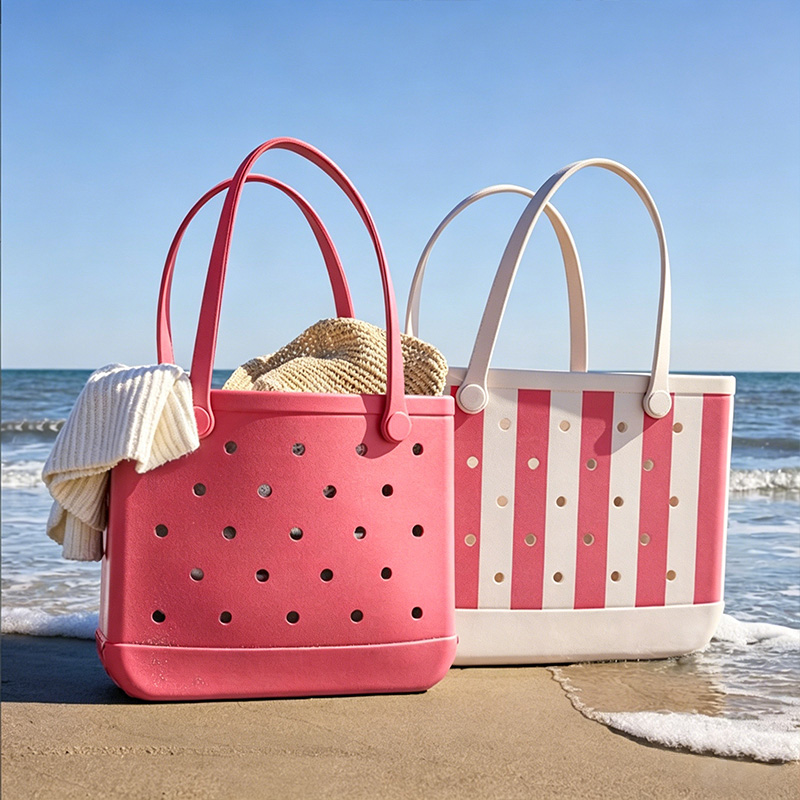
Choosing a manufacturer involves more than comparing unit prices. Buyers should evaluate the supplier's experience with the relevant material, available forming methods, tooling capabilities, customization support, and quality management process.
Useful questions include:
What material is used for the rubber beach bag?
Which molding or forming process is suitable for the design?
Can the factory develop custom shapes, colors, and logos?
Is a pre-production sample available for approval?
What quality inspections are conducted before shipment?
What are the minimum order quantity and production lead time?
Buyers should also confirm whether tooling costs, sample fees, packaging, and testing are included in the quotation. Written specifications and approved samples help establish a consistent reference for mass production.
The manufacturing process for a rubber beach bag typically involves material selection, design development, molding or forming, finishing, handle assembly, branding, quality inspection, and packaging. The exact steps depend on whether the product is made from natural rubber, synthetic rubber, EVA, a thermoplastic elastomer, or another material.
For businesses developing a custom product, working with an experienced rubber beach bag manufacturer can help clarify material options, production methods, mold requirements, and quality standards. Confirming these details before bulk production is an effective way to reduce manufacturing risks and achieve a product that meets the intended design and performance requirements.



Mobile: +86-135-3230-8701
E-mail:DGluneng001@njdbj.com
Add: 202, Building 1, No. 3, Huangjiang North Bank Fourth Road, Dongguan, Guangdong, China
© 2026 Dongguan Lvneng Rubber And Plastic Products Co., Ltd. All rights reserved.
Privacy policy | Terms and Conditions